Overview
Figma, Miro, Canva, Zoom
Challenge
Role
Time
Tools
This UX case study explores how to redesign the hotel booking flow based on usability testing and user research. The goal was to identify pain points in the booking journey and create a simplified, more transparent user flow that improves discovery, clarifies options, and streamlines checkout.
User testing revealed recurring frustrations across multiple booking sites:
🏖️ Difficulty finding hotels near desired locations
🍳 Unclear if breakfast was included in the price
🔁 Confusion around refundable or changeable rooms
💳 Checkout pages lacking a clear summary
🛏️ Room features and add-ons not visible enough
➡️ These insights highlighted the need for a clearer, more intuitive booking journey.
UX designer (solo): Notetaker, Moderator, Workshop facilitator, Information Architecture, Webdesign, with peer support for tests and card sorting
Sector
Hospitality – Hotel booking flow
12-month UX Design Institute program
Project:
Simplifying Hotel Booking Website
Validation
I tested the mid-fidelity prototype with a new participant.
Method:
Usability Testing – Validated the redesigned booking flow with user.
Annotated Screens – Captured feedback and identified opportunities for future improvements.
Key takeaway:
User appreciated clarity of summary and add-ons.
Curiosity emerged around the membership option (not the main focus of the test, but surfaced as interesting).
The mid-fidelity prototype provided valuable insights, but a high-fidelity version with complete flows would allow for deeper user validation.
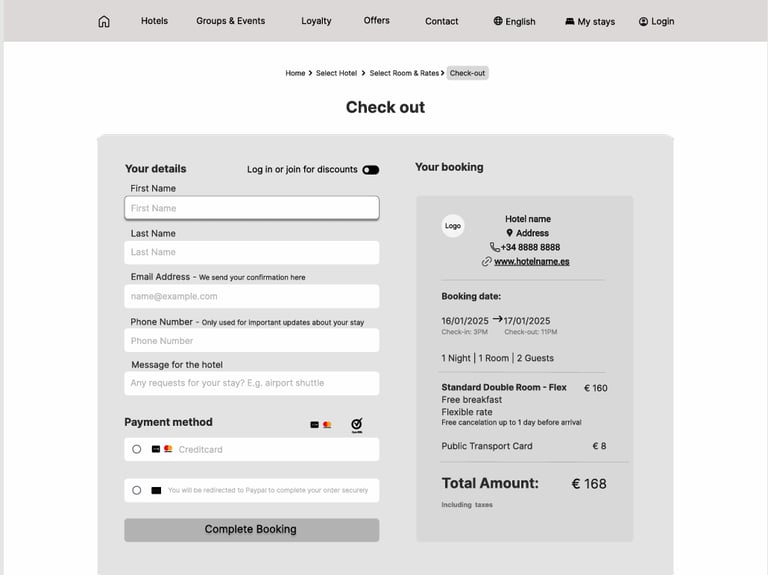
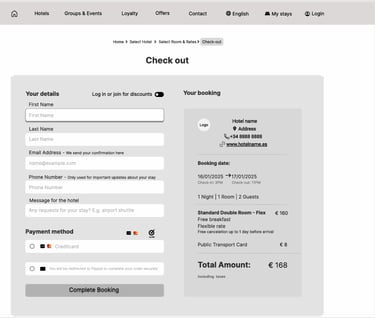
Usability Testing → Testing the new booking flow with users
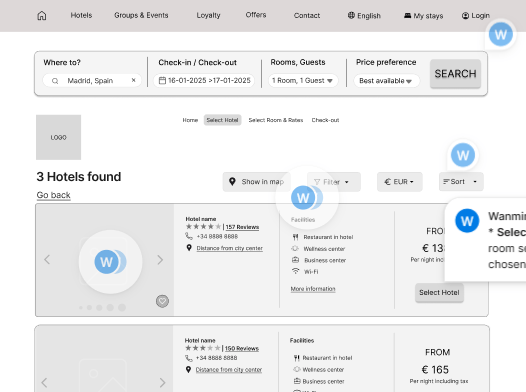
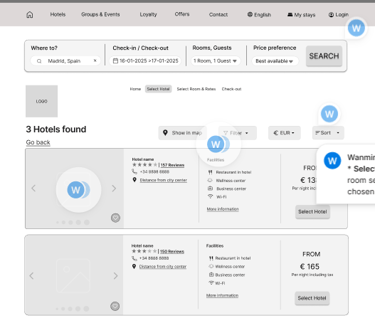
Annotated screen → Explaining layout, hierarchy, and interactions
Outcome & Learnings
This project strengthened my skills in:
User research: Synthesizing notes from provided and self-conducted interviews
Information architecture: Restructuring booking flows for clarity
Prototyping & iteration: Translating research into testable solutions
Reflection:
This project honed my UX skills and reinforced that design is iterative.
Even in mid-fidelity, testing revealed valuable insights (e.g., membership appeal)
Aha moment: the importance of designing not just for the obvious use cases, but for potential user interests too
I learned to turn user insights into clear flows and look forward to applying even more testing, stakeholder input, and high-fidelity prototyping in future projects.
Next Steps
This case study reflects my end-to-end UX design process: from research and analysis to prototyping, handover, and validation. I look forward to applying these skills to real-world challenges.